
January 22, 2026
AS FEATURED IN THE ST. LOUIS BUSINESS JOURNAL
This piece was originally published as part of the St. Louis Business Journal’s “Big Ideas for the STL Region” editorial series. In it, Triton Group CEO Greg Janson explores how place-based infrastructure investment can catalyze long-term economic and environmental value.
The same systems-level thinking informs Triton Group’s approach to materials, infrastructure, and demand creation.
STL Business Journal subscribers can read it here. Not a subscriber? Read Greg’s unedited submission here.
I’m not a brewer, and I’m not a real estate developer. I’m actually in the plastic recycling and manufacturing business—though there’s a future “big idea” there for another day. I’m not even originally from St. Louis. But I’ve lived here for nearly 30 years. I’ve raised six kids here—five of whom, unfortunately, now live in Chicago.
I love St. Louis. And I’m tired of watching us fall behind.
What we need is an idea that reaches boldly into the future while standing firmly on the foundation of who we have always been. I don’t remember exactly when this idea first took hold, but once it did, I couldn’t shake it.
Maybe it was the afternoon I was sitting in the tasting room at Side Project Brewery in Maplewood, killing 30 minutes while waiting for a pizza. Two guys sitting next to me were clearly from out of town. I asked what brought them to St. Louis. They said they were here for the entire week of Side Project’s new beer releases.
Then one of them said, almost casually, “Don’t you know this is the best brewery in the country?”
They had driven in from different cities. They had met through their shared love of Side Project beers. And they had rented an Airbnb for the entire week just to be here – because of beer.
I was floored. I had no idea.
That moment changed how I saw St. Louis—and how the rest of the world could see us too. I think that’s when this idea truly took hold: not just great breweries scattered across a region, but something bigger. Something intentional.
A Brewery District.
A Big Idea for St. Louis: The Brewery District
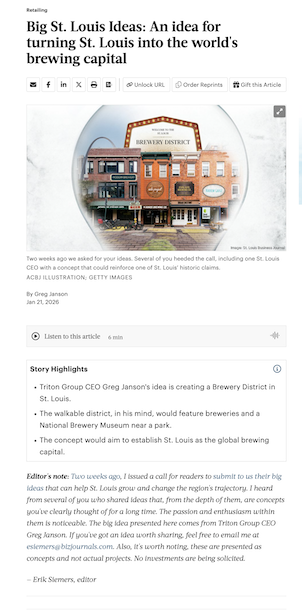
St. Louis is uniquely positioned to do something no other American city can fully claim – become the global epicenter of brewing culture, expertise, and lifestyle. Few regions can match our depth of brewing history, our modern craft-brewing excellence, or our deep German heritage. The moment is ripe to bring these assets together into a single, transformative vision.
Several years ago, I read The House of Mondavi: The Rise and Fall of an American Wine Dynasty by Julia Flynn Siler. One detail has stayed with me ever since. In the 1950s, Napa Valley was not yet the world-renowned destination we know today. In fact, the State of California planned to run an interstate highway straight through it. What changed the course of that region was the vision of one man. Robert Mondavi imagined Napa Valley as a global center for world-class wine, food, and lifestyle. That vision reshaped land use, policy, tourism, and ultimately an entire regional identity.
St. Louis deserves — and can realize — a similar transformation.
The Vision
Imagine a designated Brewery District within the City of St. Louis, thoughtfully planned and intentionally curated. A place where brewers—large and small—come together in a single, walkable district. Each brewer would maintain either a working brewery or a tasting room within the district, creating a dense ecosystem of innovation, collaboration, and craftsmanship.
The district would be located adjacent to one of our great urban parks—Forest Park or Tower Grove Park—integrating nature, recreation, and culture. Streets would be shaded by trees and designed for people, not cars. Walking and biking would be the primary modes of transportation. Outdoor cafés, bakeries, delis, coffee shops, and restaurants would line the streets, creating a vibrant but relaxed daytime and evening experience.
The nearby park would extend the experience: picnic areas, open lawns, and even horse-drawn carriage rides that connect St. Louis’s historic character with a modern, family-friendly destination.
Each September, the district would host a world-class Oktoberfest—an event rooted in tradition, craftsmanship, and community rather than excess. A celebration worthy of St. Louis’s brewing legacy.
A National Anchor
At the heart of the district would stand a National Brewery Museum—a cultural institution on par with the Museum of Westward Expansion at the Arch or the National WWII Museum in New Orleans. This museum would tell the story of brewing as technology, art, science, and culture, with St. Louis at its center. It would serve as both a national draw and an educational anchor, reinforcing the district’s credibility and long-term relevance.
What This Is — and Is Not
From the outset, this must not be conceived as a party district or nightlife corridor akin to Bourbon Street. This is not about bars and excess. It is about charm, safety, craftsmanship, learning, and pride of place. A destination people visit because it is beautiful, interesting, and authentically St. Louis—a place families, tourists, locals, and international visitors all want to experience.
Why Now
We are living in a golden age of brewing. The talent, knowledge, and creativity concentrated in St. Louis today are extraordinary. But moments like this do not last forever. Regions that define themselves early become leaders; those that hesitate become footnotes.
St. Louis has the history. St. Louis has the talent. St. Louis has the credibility.
Now is the time to claim our future. Let us seize this moment. Let us define the Brewery District.
Let us establish St. Louis as the brewing capital of America—and the world.
Triton Group’s work is rooted in the belief that durable infrastructure and long-term thinking are essential to economic and environmental progress. Whether applied to regional development or material systems, the principle is the same: lasting value comes from solutions designed to perform over decades, not quarters.