
August 18, 2026
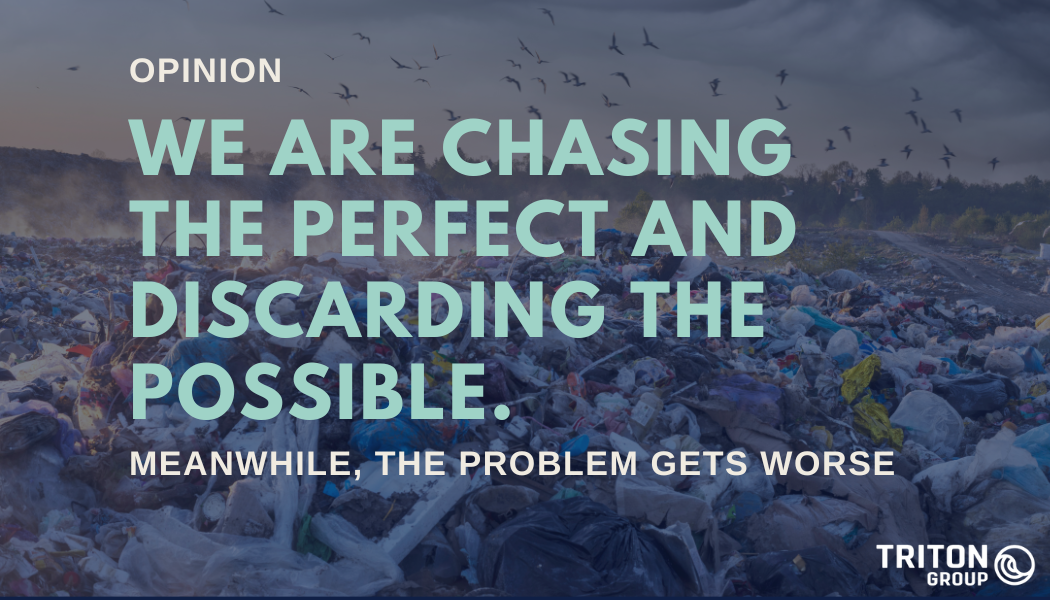
We Are Chasing the Perfect and Discarding the Possible. Meanwhile, the Problem Gets Worse.
By Greg Janson, CEO, Triton Group
If you read my last piece, you know my argument. Plastic recycling is currently organized around an ideal, single pathway of package-to-package mechanical recycling, and that pathway can realistically handle about 15% of the post-consumer plastic that needs a home. The other 85% needs somewhere to go. I laid out three legs in that piece: mechanical recycling back to packaging, mechanical recycling to durable goods, and pyrolysis. I argued that EPR frameworks do not properly support the durable goods end market, that significant parts of our own industry still treat durable goods as a second-class solution, and that we are missing a large opportunity by delegitimizing pyrolysis.
The structural problem I described is real, but it does not explain itself. Systems do not stay broken by accident. They stay broken because the people inside them are organized around a set of beliefs that once made sense but have not evolved with market realities.
Here is the belief I want to challenge: that embracing pyrolysis, and by extension mass balance accounting, and by extension the participation of large petrochemical companies in the recycling system, is somehow a compromise of what recycling is supposed to be.
That belief is costing us enormously. It is costing our industry, and it is costing our environment.
The Adversarial Frame Is the Problem
The plastic recycling industry has deep roots in environmentalism. That is not a bad thing. Environmentalists and environmental trade groups care deeply about what they are doing and why. But one byproduct of those roots is a worldview that treats petrochemical companies as the enemy. I often hear that virgin plastic is the problem and that the companies that make it are the obstacle. Many think that for recycling to win, virgin plastic has to lose. I understand where that sentiment comes from, but I do not think it is useful if we hope to scale plastic recycling.
This adversarial framing has created inertia in solving the problem. Pyrolysis is a good example. When it is proposed as a legitimate recycling pathway, it often meets resistance. Some of that resistance is warranted: the technology is imperfect and deserves scrutiny. But some of it stems from a deeper tension. The companies best positioned to benefit from pyrolysis at scale are many of the same petrochemical companies the recycling industry has spent decades positioning itself against. For many in the industry, embracing pyrolysis can feel less like accepting a new technology and more like letting the wrong people under the tent.
Pyrolysis as an Economic Foundation
There is a myth I want to correct, because it does more damage than the critics realize, and some of pyrolysis’s own advocates repeat it. The myth is that pyrolysis is where you send the highly contaminated material nobody else can use because it’s too dirty. This isn’t the full story nor the primary benefit that pyrolysis brings to the industry.
Pyrolysis converts polyolefins back to oil. Olefins are what it wants. Anything that is not an olefin is a contaminant, and it does not quietly disappear. It builds up as char and fouls the reactor. So while pyrolysis can accept some olefin streams that mechanical recycling cannot, a good pyrolysis feed is not a garbage stream. It is sorted, olefin-rich, reactor-ready feedstock.
Here is what pyrolysis does not care about. It does not care about melt flow within a range. It does not care about color. It does not care about odor signature. It does not care whether the resin is FDA grade. It does not care about polyethylene-to-polypropylene ratios, high-density versus low-density, IZOD, or flex modulus.
That indifference is the entire point, and it is where the real value lives.
Think about who buys mechanically recycled resin. Molders. And molders are buying properties. Every virgin polymer is engineered to hit a specific set of properties for a specific job, whether that is food shelf life, or clarity, or the durability to survive a supply chain. When a molder buys recycled resin, they need those same properties held within tight tolerances. Every time you add a processing step to hit a property target, it costs money and it shrinks the volume you can sell.
Pyrolysis is not buying properties. It is buying polymers. It will take the full spectrum of melt flows, colors, grades, and densities that no molder can use, and it will take it at volume. There is no mechanical recycling market that can absorb that variety at scale. It does not exist.
That is why pyrolysis is not a dumping ground. It is an economic foundation. It gives reclaimers a guaranteed home for the wide band of material that falls outside any single property specification, which is exactly the material that gets stranded and landfilled today. Not because it is dirty, but because it does not fit a narrow spec. Give that material a large, reliable market and the economics of reclaiming change for everyone upstream of it.
Economic Interest Is Not the Enemy
I am a realist. People do things when it is in their economic interest to do them. This is the force behind every meaningful shift in how human beings organize around a problem.
Voluntary recycling has struggled to scale because the economics do not support it. When virgin plastic is cheaper and more consistent than recycled, the market defaults to virgin. When the virgin market spikes, recycled resin becomes more attractive. Similarly, when legislation mandates recycled content, the market scrambles to find supply. The behavior follows the incentive every time.
The question is not how do we get people to act against their economic interest in the service of a greater good. That does not scale. The question is how do we align economic interest with the outcome we are trying to achieve.
Pyrolysis does that. When a petrochemical company can route post-consumer polymers through a refinery, attribute a percentage of that volume to recycled content through mass-balance accounting, and sell it to brands seeking to meet their obligations, the plastic recycling industry wins. The reclaimer has a market for a wide band of material that can be efficiently processed. The petrochemical company has a legitimate recycled content business. The brand has a credible path to compliance. And a stream of plastic that would otherwise be landfilled has somewhere to go.
That is recycling scaling, not failing.
And yes, the technology is still imperfect. It will not mature in a vacuum. Pyrolysis improves the same way every technology improves, by reaching the scale that funds the next round of engineering. Starve it of a market and it stays where it is. Give it a market and it gets better. Withholding demand until the technology is perfect guarantees it never becomes perfect.
Inviting the pyrolysis players into the solution is not a concession. It is one of the ways to get from where we are to where we need to be.
The Perfect Is the Enemy of the Scalable
We tend to discard the possible in this industry in pursuit of an unrealistic perfect. I have said that before, and I will keep saying it until it is no longer true. I look forward to that day.
The imaginary perfect recycling system, in the view of its most idealistic advocates, looks something like this. Every piece of plastic is collected, sorted, mechanically recycled back into a product of equal or greater value, and the petrochemical industry drastically shrinks. Brands are forced to use recycled resin that does not perform as well as virgin and is more expensive, but wins on principle.
That may be a fine vision. It is also a fantasy.
The realistic path forward is threefold. It includes mechanical recycling back to packaging where it works, which is meaningful but limited. It includes aggressive development of durable-goods end markets, infrastructure, construction, and high-volume industrial uses that can absorb massive quantities of mixed olefins. And it includes pyrolysis as a complement to mechanical recycling and as the economic foundation that keeps reclaimers in business.
Where This Leaves Us
The industry needs to make a choice. It can stay organized around a purity argument that feels righteous and does not scale. Or it can build a system that is realistic about human motivation, inclusive of every end market that actually exists, and serious about moving the volume of material the problem actually requires.
That means treating durable goods as a primary market for mixed olefins, not an afterthought. It means supporting pyrolysis. It means embracing mass balance. It means letting petrochemical companies participate in the solution. It means choosing the possible over the perfect.
The industry is at an inflection point. For those who disagree with my three-pronged approach to solving the problem, I would ask them to provide an alternative plan for realistically addressing the 85% of plastic waste that package-to package recycling cannot handle.
I am truly interested in how others are reconciling these gaps. If you are working on a different roadmap, reach out.
The plastic recycling industry will not survive a system that ignores economic realities and only works in principle. Let’s not discard the possible by chasing the unachievable perfect.
_______________________________________________________________________________________________________
Greg Janson is the President and CEO of Triton Group, a St. Louis-based processor of post-consumer polyolefins supplying engineered feedstocks to infrastructure and advanced chemical recycling markets. They also produce the Triton Tie, a composite rail-tie made of the same feedstock reinforced with glass-fiber to make them stronger than wood and lasting 4 times longer.