
April 21, 2026
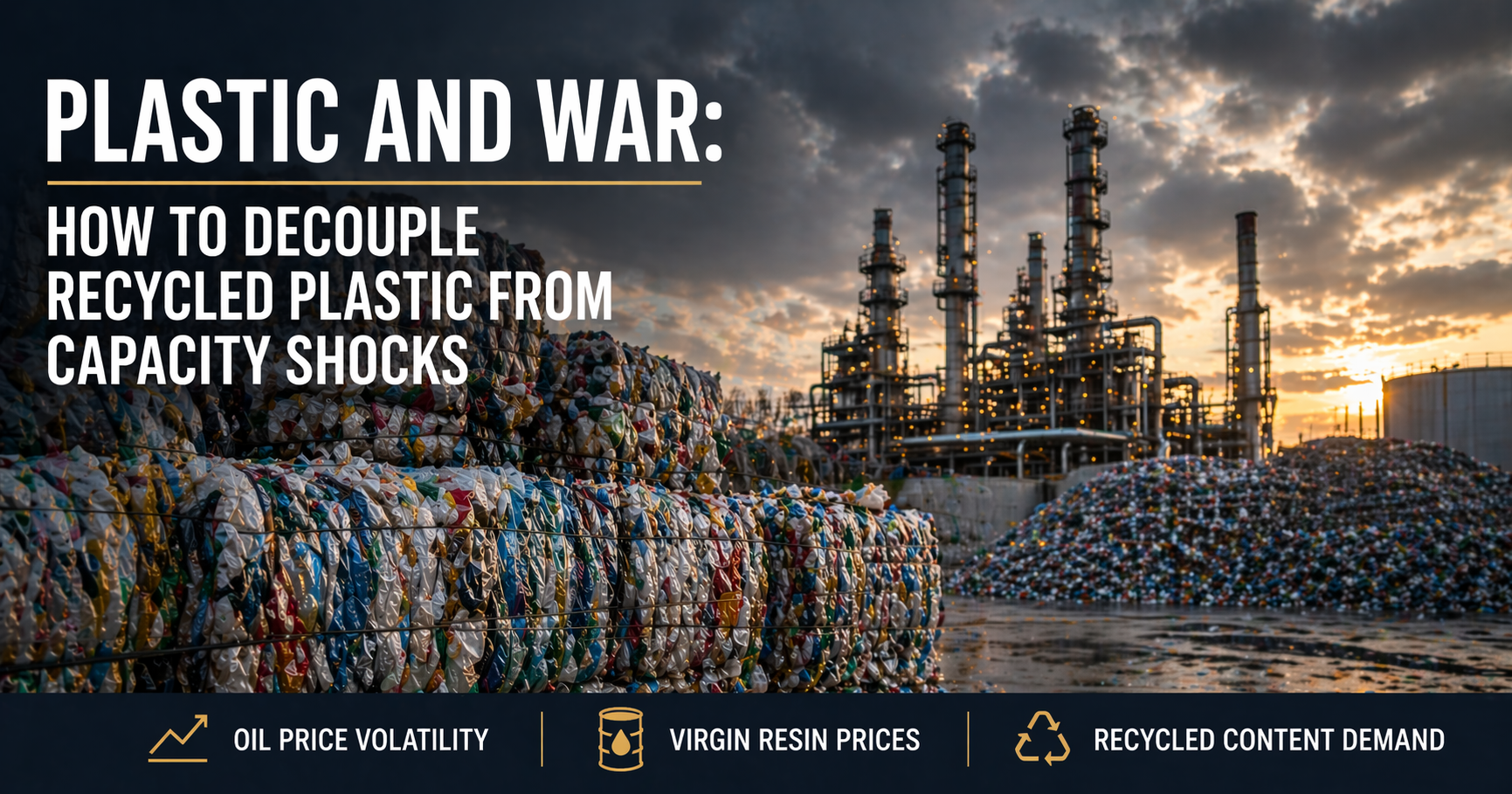
Plastic and War: How to Decouple Recycled Plastic from Capacity Shocks
By: Greg Janson, CEO Triton Group
If recycling only works when a cataclysmic event takes place, we haven’t built a system. We are gambling in a casino.
Right now, recycling markets are improving. But maybe not for the reason you think.
Virgin plastic prices are surging—but the primary driver isn’t the price of oil. It’s capacity disruption. Missile strikes on petrochemical facilities in the Middle East have crippled production capacity. Qatar’s Ras Laffan facility was damaged. The Strait of Hormuz is effectively closed. Over 30% of the global petrochemical trade is disrupted. Recycled plastic is suddenly competitive again.
Material is moving. Demand is ticking up. On the surface, it looks like progress.
But I’ve spent 28 years in this industry, and I know what’s coming next.
Most people misunderstand how wars, hurricanes, and ice storms affect plastic recycling. They assume it’s about rising oil prices. That’s only half the story.
What actually happens is this: catastrophic events cripple petrochemical plant capacity. When production facilities go offline, damaged by strikes, ice storms, or hurricanes, virgin plastic supply contracts. Reduced supply pushes prices up. Higher prices then force manufacturers and converters to turn to recycled material because it’s now economically viable.
That’s what’s happening right now. Iranian missile strikes have taken approximately 15% of petrochemical production capacity offline in the Persian Gulf. Petrochems have sharply raised virgin prices. Recycled plastic is back in demand—temporarily.
But here’s the crucial point: when that capacity comes back online, or is replaced by other plants surging, prices fall again. And when virgin prices fall, recycled plastic loses its price advantage, and recyclers are left holding the bag (or super sacks!). . . again.
As I’ve said before – a war, a hurricane, or an ice storm is not a business strategy.
THE DEEPER STRUCTURAL PROBLEM: MASSIVE OVERCAPACITY FOR VIRGIN
The real threat to the viability of recycled plastic is permanent virgin production overcapacity.
Fracking has unlocked an abundance of cheap oil and LNG, particularly in the US and Canada. This sparked a massive global build-out of virgin plastic production capacity. Petrochemical companies invested billions in new plants—not just in the Middle East, but across North America, China, Southeast Asia, and Europe.
That capacity will over-supply the market for decades.
When this current conflict ends and the Strait of Hormuz reopens, the disrupted capacity will come back online. Prices will normalize. And recycled plastic will be undercut again—just as it has been after every previous disruption and shock.
This is the pattern that repeats:
- 2014-2016: Oil prices collapsed, virgin plastic became cheap, and recycled demand evaporated.
- 2020: COVID-related supply shock, then rapid capacity recovery, then prices fell again.
- 2024-2025: Energy abundance, overcapacity, and recycled plastic struggling.
- 2026 (now): Geopolitical disruption, temporary price spike, recycled demand returns.
- Next cycle: Capacity recovers, prices fall, recycled plastic loses again.
This is a casino, not a system.
The fundamental constraint isn’t whether we can collect material. We can. The constraint isn’t whether we have temporary demand spikes. We do. The constraint is that recycling infrastructure cannot be built on temporary demand.
RECYCLING NEEDS DEMAND THAT ISN’T HELD HOSTAGE TO CAPACITY CYCLES
If recycling is going to work long term—if it’s going to be viable through both abundant and constrained capacity environments—it needs demand that is fundamentally different from what the packaging market offers.
In packaging, recycled material has to compete with virgin plastic on price. And it’s expensive for recyclers to make package-ready material. When virgin gets cheap, recycling loses. When virgin gets expensive, recycling wins—but only temporarily. That’s not a strategy worth investing in. That’s a spot trade.
We need demand that operates on a different logic entirely.
TWO PATHS TO DURABLE DEMAND
There are two strategic categories in which recycled plastic can escape commodity volatility: infrastructure and advanced chemical recycling.
INFRASTRUCTURE: LONG-LIFE PRODUCTS, CONTRACTED DEMAND
Infrastructure products—railroad ties, utility products, construction materials, bridge components, and transportation systems—operate on fundamentally different economics than packaging.
First, they can use a broader range of post-consumer plastics. Infrastructure doesn’t require food-grade, color-controlled, highly processed material. This expands the usable supply and immediately improves processing economics.
Second, and more critically, they demand material at scale and at a price point that virgin cannot compete with. 20 million railroad ties are replaced annually in the US – 14 million in accelerated decay zones. That’s 2.24 billion lbs of recycled plastic that can be tied to a contract. When recycled plastic is locked into a spec that lasts decades, oil prices, geopolitical disruptions, and capacity cycles become irrelevant.
The economic equation changes. Infrastructure demand is durable.
PYROLYSIS: CHEMICAL ADVANCED RECYCLING AS A SECOND PILLAR
The second path is chemical advanced recycling—pyrolysis and similar technologies that convert difficult plastic streams back into feedstock for petrochemical plants and refineries.
Pyrolysis creates demand for plastic waste that cannot be efficiently processed for use in packaging and many other mechanical recycling markets. Post-consumer films, mixed PE/PP streams, contaminated material—these are materials that would otherwise be landfilled. Pyrolysis operators need a recurring, long-term feedstock supply to run their reactors economically. That creates contractual demand that cannot be filled with cheap, virgin plastic.
When recycled plastic is supplied to a pyrolysis reactor that’s producing feedstock for major chemical producers under supply agreements, the revenue isn’t dependent on whether virgin plastic is expensive or cheap. It’s dependent on the pyrolysis operator’s production commitments and long-term contracts. That demand is stable.
This is not ideology. It’s engineering and commerce.
THE PROOF: HOW THIS ACTUALLY WORKS
At Triton Group, we’re building this exact model. Our strategy operates on two fronts:
We create engineered feedstocks from challenging plastic streams. We take material that traditional recycling can’t use efficiently and direct it toward two destinations. First, infrastructure products. In our case, it’s composite railroad ties and material handling products. Second, we supply reactor-ready feedstock to pyrolysis operators, creating contractual demand for difficult streams that mechanical recycling would struggle with or that the market cannot absorb.
In both cases, the key is the same: durable, long-term, contracted demand. When recycling is tied to infrastructure lifecycles, or chemical advanced recycling agreements rather than commodity prices, the system becomes economically resilient.
This is what will allow recycling to scale. Not by forcing material back into the same product it came from. But by creating multiple, durable end markets with contractual demand, not cyclical.
WHAT THIS REQUIRES
As regulatory frameworks like Extended Producer Responsibility expand, there will be increasing pressure to recover more material. Recovery is essential. But recovery alone isn’t the solution. You can recover all the plastic in the world. If there’s nowhere durable for it to go, it doesn’t matter.
The second half of the equation is ensuring that recovered material has stable, long-term, contracted destinations.
If we continue to build systems in which recycling’s viability rises and falls with geopolitical shocks and capacity cycles, we will continue to see boom-bust patterns. Material moved one year, landfilled the next. Infrastructure investments are wasted. Workers are laid off when demand collapses.
But if we deliberately build durable end markets—infrastructure, chemical advanced recycling, and other applications that operate under long-term contracts—we create a system that is:
Economically resilient regardless of oil prices or geopolitical volatility. Operationally scalable because demand is contractual, not speculative. Capable of absorbing the massive flow of material that EPR regulations will compel.
THE BOTTOM LINE
Oil prices will always fluctuate. Wars will come and go. Capacity will be built, destroyed, and rebuilt. Supply chains will shift.
A recycling system that depends on those variables will always be fragile.
A system built on durable, long-term, contracted demand will not.
The future of recycling doesn’t depend on how much we collect or how temporary the price spikes are. It depends on whether we build the business discipline to create and maintain stable, long-term end markets that survive commodity cycles and geopolitical volatility.
That’s the shift that needs to happen. Not better collection technology or higher public participation—those matter, but they’re not sufficient.
Better end markets. Contracted demand. Multiple destinations. Long-term vision.
That’s where the real opportunity is. And that’s what we’re building at Triton.