
July 8, 2026
Why Plastic Recycling Keeps Falling Down – and How to Fix It
If you read my last piece, you know where I stand on the lack of foundational demand in the plastic recycling industry. Recycling markets that rise and fall with geopolitical shocks and virgin capacity cycles are not markets worth building on. They are spot trades dressed up as strategy, more akin to gambling in a casino than actually scaling a business.
But I want to go a level deeper. What creates that foundational demand? What does a system actually look like that can stand on its own and not collapse the moment oil and natural gas prices fall and capacity gets back online?
The answer is not complicated. But it requires the industry, and critically the people setting policy and defining recycling standards, to stop organizing around one leg of a stool and start thinking about all three.
The Stool We Are Not Building
The plastics recycling conversation, at the policy and trade association levels, is overwhelmingly focused on package-to-package recycling. Take a plastic container, recover it, process it via mechanical recycling and put some percentage of recycled content back into a new plastic container. That is what Extended Producer Responsibility (EPR) frameworks in California and elsewhere are written to reward. That is what brands are being asked to demonstrate. That is the metric that defines success or failure in most recycling compliance conversations right now.
I understand why. It is the most visible and intuitive loop – use the waste plastic container to make the new plastic container. The logic is clean on paper.
The problem is that this is only one leg of the stool and a one-legged stool cannot stand. The package-to-package pathway requires food-grade, color-controlled, tightly specified material. The supply of this material is limited. The processing cost to get there is high and even technically impossible in many instances. And when the resulting PCR resin has to compete with virgin on price, it loses every time. As long as virgin capacity is abundant, which, structurally, it will be for decades given global petrochemical build-out trends, package-to-package PCR will lose.
Brands trying to meet their recycled content obligations are already running into this wall. In some cases, even at a premium price; the supply simply does not exist in sufficient volume to meet what the law requires. That is not a collection or processing problem. That is a demand architecture problem.
When you build a compliance framework around a single, non-scalable pathway, you do not get a recycling system. You get a mandate that generates lawsuits.
The Three Legs
A stool needs three legs to stand. In plastics recycling, those legs are package-to-package, durable goods, and advanced chemical recycling. Each one serves a different function. None of them alone is sufficient. All three together create something that can actually hold weight.
Leg One: Package-to-Package Compliance
This leg is real, and it matters. Brands need recycled content in their packaging, and there is genuine demand for it. The issue is not that this pathway should be abandoned. The issue is that the current policy architecture treats it as the only legitimate destination for recovered plastic, which starves the other two legs of the demand they need.
Package-to-package should remain a priority. It just cannot be the whole answer.
Leg Two: Durable Goods
This is the leg the industry systematically undervalues, and it is the one I have been arguing for most persistently.
Plastic and composite lumber, drain pipe, composite railroad ties, construction materials, pallets and other material handling products, are fundamentally different from packaging in one critical way: they are not competing with virgin plastic on price in the same commodity market. They are competing with entirely different legacy materials. Wood. Steel. Concrete.
Why is this important? Because the greatest value of recycled plastic is realized when it competes against legacy materials rather than virgin plastic. In those applications, products made with recycled content deliver superior performance. Take composite railroad ties as an example. They are not competing in a price war against low-cost virgin resin—they are winning on performance against wood. Even when treated with toxic creosote, a wood tie in high-decay environments typically delivers less than 25% of the service life of a composite tie. That shifts the discussion from commodity pricing to lifecycle performance, durability, and total cost of ownership—a fundamentally different conversation.
Durable goods also absorb a broader range of post-consumer material. Infrastructure applications do not require the same stringent specifications as food-contact packaging. That means processors can work with more of the mixed, contaminated, difficult streams. Many of which are currently being landfilled.
The scale of the opportunity here is significant. Railroad ties alone represent a demand potential of over three billion pounds of PCR annually in North America. Add utility infrastructure, material handling products, construction components, and agricultural products, and you are talking about end markets that could absorb over ten billion pounds of post-consumer material annually under long-term, contracted demand.
And yet, under most current EPR frameworks, a brand that diverts post-consumer plastic into durable goods receives no credit toward its recycled content obligation. That is a policy failure. It is organizing the incentive structure around the narrowest possible pathway while ignoring the one that actually scales.
Durable goods are not downcycling. A product that performs for decades, displaces a legacy material in a high-performance application, delivers a positive economic impact, and can be recycled at its’ end of life is exactly what a serious recycling system should be rewarding.
Leg Three: Advanced Chemical Recycling
The third leg is pyrolysis and related advanced chemical recycling technologies. Despite its potential, this pathway is facing substantial headwinds, many stemming from the current policy environment.
Let’s look at the fastest-growing packaging solution today, film and flexibles. Film and flex is the most problematic plastic stream in the recycling system. It is not a polymer. It is a packaging type. It contains a mix of materials including LDPE, LLDPE HDPE, PP, PET, barrier layers, copolymers, and co-materials. It is highly engineered to give the package a functional mission. And it does that mission exceedingly well. But that functional complexity makes film and flex impossible to process back into packaging through mechanical recycling at scale. We are trying to force a square peg into a round hole.
Pyrolysis exists precisely to handle this kind of stream. It takes material that mechanical converters cannot efficiently use, transforms it into pyrolysis oil, and feeds that oil into petrochemical refineries, where it becomes feedstock for new products, including virgin-like plastic. The logic is sound. The technology works. The demand signal from major chemical producers is real.
But pyrolysis is being undermined by two policy positions that, taken together, make the pathway economically challenging.
The first is the fuel carve-out maintained by many organizations, which withholds recycling credit from pyrolysis oil that ends up as sustainable aviation fuel (SAF) rather than as new plastic. The second is the rejection of mass-balance accounting, which is the only practical way to attribute recycled content when molecules from multiple feedstocks are commingled in a refinery. Without mass balance, a pyrolysis operator cannot credibly claim recycled content for its output. Without recycled content claims, brands cannot use pyrolysis-derived resin to meet their EPR obligations. Without that demand signal, pyrolysis cannot attract the long-term contracts it needs to scale.
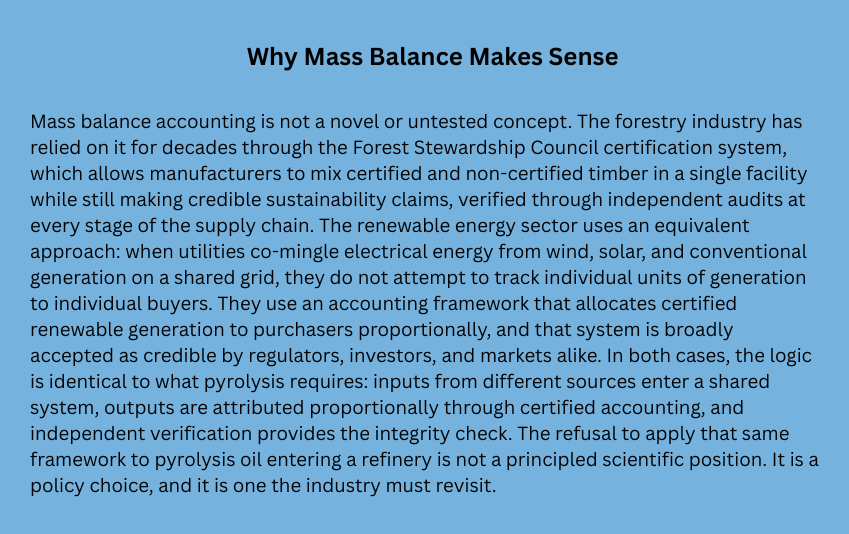
The result is a technology that could handle enormous volumes of difficult material, sitting underutilized because the policy architecture does not credit it in a way that makes the economics work.
Supporting advanced chemical recycling as a legitimate pillar of the recycling system is a common-sense approach to generating realistic demand. If the goal is to find enduring, scalable end markets for post-consumer plastic, advanced chemical recycling technologies like pyrolysis need to be in the system, with the policy support and accounting frameworks that make it viable.
What Needs to Change
The policy conversation needs to catch up to the economic reality.
- EPR frameworks should credit brands for the use of post-consumer recycled content in durable goods, not only for packaging applications. A company that incorporates significant PCR into its pallet supply chain or infrastructure procurement is doing exactly what the system is trying to incentivize. The current structure ignores that.
- The plastic recycling industry needs to take a full-throated position in support of pyrolysis, including mass-balance accounting and the elimination of the fuel carve-out. Supporting advanced chemical recycling in principle while maintaining policy positions that limit its ability to scale is not a coherent stance.
- Policymakers and regulators need to stop treating package-to-package recycling as the default definition of recycling success. The framework should measure plastic diverted from landfill and directed toward enduring, long-term, contracted uses, regardless of whether those uses are packaging, infrastructure, or petro-chemical feedstock.
Where Triton Fits
At Triton Group, this is not theory. We process mixed post-consumer polyolefin-heavy streams, including film and flexible packaging, into engineered feedstocks for exactly these applications: composite railroad ties, durable goods, and reactor-ready feedstock for advanced chemical recycling operators. Our model is built on the premise that enduring, contracted demand is the only kind worth investing in.
The material we process would largely be landfilled under a system organized solely around package-to-package recycling. It does not meet the specification. But directed toward infrastructure and advanced chemical recycling, it has a reliable home and contracted buyers.
That is what the three-legged stool looks like in practice. It is the model the industry must build toward through coordinated policy, targeted investment, and thoughtful standards development—before the next geopolitical shock temporarily masks the underlying problem and we once again mistake luck for strategy.
_______________________________________________________________________________________________________
Greg Janson is the President and CEO of Triton Group, a St. Louis-based processor of post-consumer polyolefins supplying engineered feedstocks to infrastructure and advanced chemical recycling markets. They also produce the Triton Tie, a composite rail-tie made of the same feedstock reinforced with glass-fiber to make them stronger than wood and lasting 4 times longer.